The Little Paris Shop That Became the First Modern Department Store
Every giant was once a shop with a door and someone behind the counter. This one began with twelve employees on a Paris street corner.
A shop of twelve
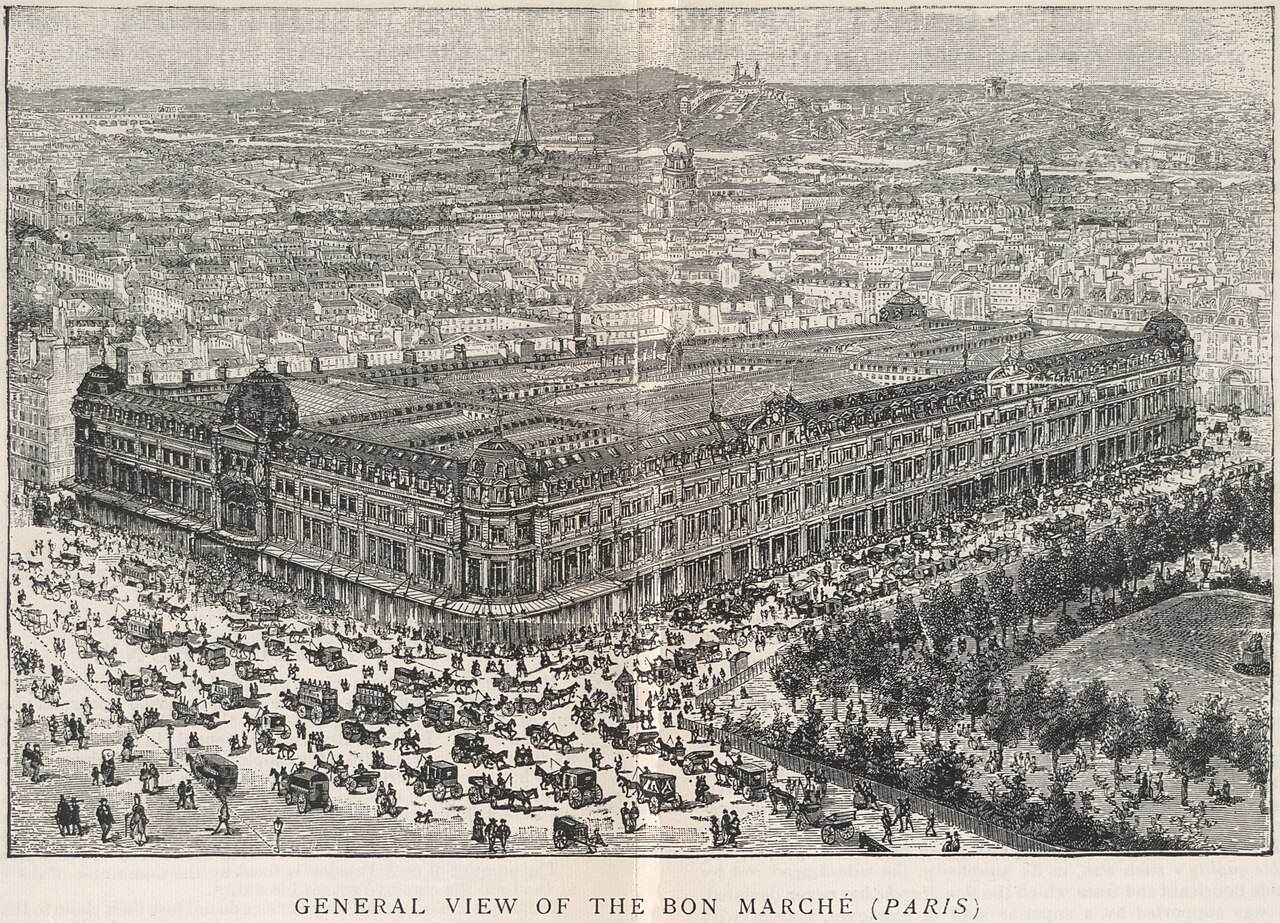
In 1838, two brothers, Paul and Justin Videau, opened a shop on the Left Bank of Paris. They called it Au Bon Marché. It sold the things a household needs and a tailor reaches for: lace, ribbons, sheets, mattresses, buttons, umbrellas. It had four departments, twelve employees, and roughly 300 square meters of floor. A neighborhood shop, in other words. The kind you would walk past without thinking it would ever change the world.
What changed it was not money. It was a shopkeeper.
The peddler and the creamery owner
Aristide Boucicaut was born in 1810 in Bellême, a small town in Normandy. He grew up behind the counter of his family's shop, then took to the roads as a traveling salesman at eighteen. In the mid-1830s he came to Paris and joined a shop called the Petit Saint-Thomas, where he rose to head of a department. He learned the trade the slow way: by watching customers.
Marguerite Guérin was born in 1816 in a Burgundy village. Her mother died when she was thirteen. She came to Paris, worked for a laundress, saved what she could, and opened a small creamery. That is where she met Aristide.
When the Petit Saint-Thomas closed in 1848, Aristide went into business with Paul Videau. By 1852, he was running Au Bon Marché. Marguerite was at his side. Two people who had spent their lives on the working side of the counter now had a shop of their own.
What they changed
The Boucicauts did not invent shopkeeping. They changed the deal between the shop and the person walking in.
- A price on every item. In most Paris shops, you haggled. The price depended on who you were and how you looked. At Le Bon Marché, prices were fixed and marked. A stranger paid what a regular paid.
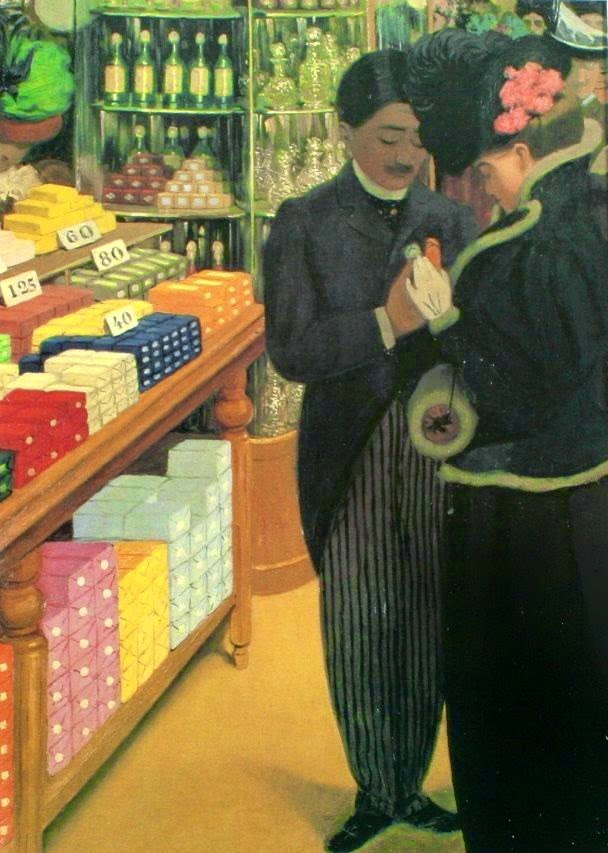
- The freedom to just look. According to the store's own history, people could walk in freely, with no obligation to buy. Browsing became something you were allowed to do.
- The right to change your mind. Goods could be exchanged or refunded. The risk of buying moved, for the first time, from the customer to the shop.
- Small margins, fast turnover. The Boucicauts bought in large quantities and kept their margins low, betting that more people would come back more often.
They added a reading room where husbands could wait while their wives shopped, seasonal sales, among them a winter "white sale" of sheets and linens, and, in 1867, a mail-order catalogue that carried the shop far beyond its street.
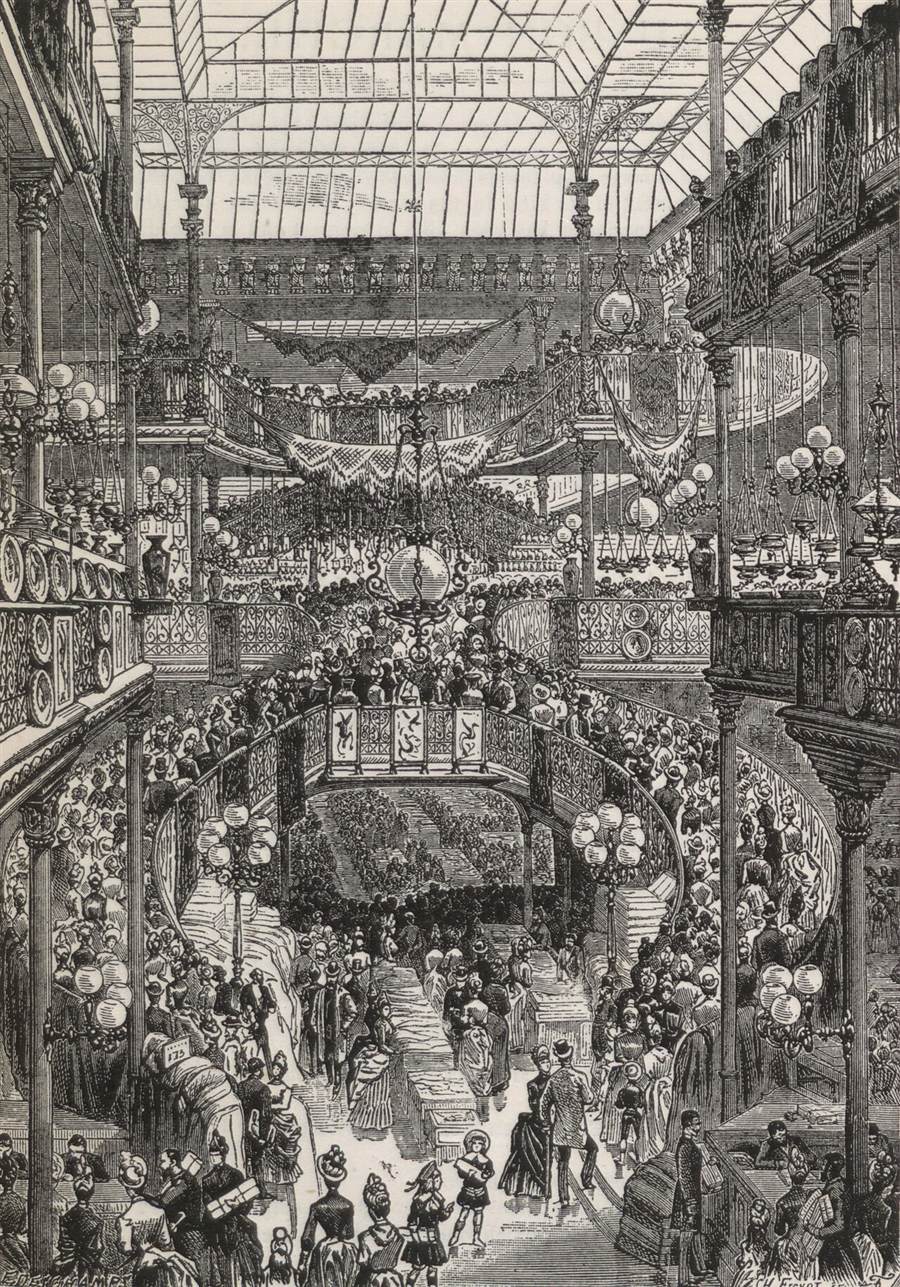
It worked. Sales went from about 500,000 francs in 1852 to some 72 million francs by 1877. In 1869, construction began on a new building on the rue de Sèvres, designed by the architect Louis-Auguste Boileau. In the 1870s, the store grew again with help from the engineering firm of Gustave Eiffel, years before his tower. The work was not fully finished until 1887.
The people behind the counter
The Boucicauts never forgot which side of the counter they had come from. By the time Aristide died in 1877, the store employed nearly 1,800 people. They set up a fund for sick employees and pensions for those who had served twenty years. There were dormitories for unmarried women on staff (by 1880, half the employees were women), and a path to move up from junior salesperson to head of a department.
After Aristide's death, Marguerite ran the store for ten more years. When she died in 1887, she left much of her fortune to her employees and to charitable causes. Part of it funded a Paris hospital that still carries the Boucicaut name.
The shops across the street
There is another side to this story, and a Frenchman told it first.
In March 1882, the novelist Émile Zola wrote to Le Bon Marché and was given a full tour. The next year he published Au Bonheur des Dames, known in English as The Ladies' Paradise. Its hero, Octave Mouret, is loosely based on Boucicaut. Its giant store is a marvel of light, fabric and ideas.
But Zola also looked across the street. In the novel, the old drapery shop of Baudu, Au Vieil Elbeuf, grows darker and emptier each season. Bourras, the umbrella maker next door, refuses to sell, and the great store builds around his little shop until he is ruined. The neighborhood's small shops close one by one. They were not beaten by bad shopkeeping. They were outgrown.
Was it really the first?
Historians still argue about that. London had shops with several departments by the 1790s, and other Paris stores were trying new methods in the 1840s. But Le Bon Marché is often called the first modern department store, because of how much the Boucicauts changed at once, and how many stores around the world copied them.
What a shopkeeper's ideas are worth
The lesson of Le Bon Marché is not that bigger is better. It is that the best ideas in retail came from people who stood behind a counter and watched other people shop.
Look again at what the Boucicauts gave their customers. An honest price. The right to walk in, look around, and walk out. A shop that took responsibility for what it sold. None of it required a warehouse. All of it required someone who cared.
Today, a lot of shopping has lost those things. Prices can shift from one visit to the next. Walking out of a store online often means being followed by its ads for weeks. And the same products show up everywhere, chosen by no one in particular.
That is why we built Tongraal the way we did. Every shop on it has a real door and a real address. Each shopkeeper picks twenty pieces, the ones they are proudest of. There is no dropshipping. And there are no trackers: you can come in, look, and leave, the way Le Bon Marché let Paris do in 1852.
The Boucicauts started with a corner shop and a few good ideas about respect. Somewhere on a Main Street near you, someone is doing the same thing right now. It's worth walking in.
Not everything should be everywhere.
Sources
- Le Bon Marché, The history of Le Bon Marché
- Bibliothèque nationale de France, Le couple Boucicaut
- Wikipedia, Le Bon Marché
- Wikipedia, Aristide Boucicaut
- Wikipedia, Marguerite Boucicaut
- Wikipedia, Department store (early history)
- Wikipedia, Au Bonheur des Dames
- Émile Zola, The Ladies' Paradise, Project Gutenberg
- Further reading: Michael B. Miller, The Bon Marché: Bourgeois Culture and the Department Store, 1869–1920 (Princeton University Press)